Moving From Grind to Grace
The CEO's path to creating cultures where both people and results flourish
Prefer listening instead of reading? Click play below.
You're sitting in your living room, Netflix is on, and your mind is still racing through scenarios you can't control. Because you're the CEO. The off switch doesn't exist.
You've read and re-read the text message from Jim on your management team, and you still don't know how to respond...or maybe you do, but you're too exhausted to deal with the fallout.
Your calendar is filled with meetings, and there’s simply not enough time to think.
From the outside, you look like you’re winning...but inside? You know something is way off.
Sure, you had a chat last week with your therapist, and you felt better for a day or two, but you still feel overwhelmed. And while you know it's unsustainable, you give yourself a pep talk and tell yourself that it's just a season, just a rough patch...the cost of building anything worth doing.
Maybe your version of this looks like:
The CEO who's built a profitable business but feels like she's holding her breath constantly, waiting for something to break. She can be killing it on paper and still spend her nights pacing the floor. She’s the kind of tired that a vacation can't fix.
The executive leading a high-performing team who has started noticing the cracks. Morale isn't quite what it was, and a few key people seem worn thin. The culture that felt energizing two years ago now feels fragile, like one more push might break something. And he's terrified of slowing down because what if the momentum dies?
The leader who's doing everything "right" by every conventional measure...hitting revenue goals, making payroll, closing deals, keeping clients happy, but she’s feeling completely disconnected. From her team, family, and even herself.
The business owner who knows he can't keep going like this, but also can't figure out how to stop. Because what happens if he admits he's overwhelmed? That feels like blood in the water...like something that could cost him everything he’s worked for.
Wherever you're coming from, the thought (and hope) is the same: This can't be the only way.
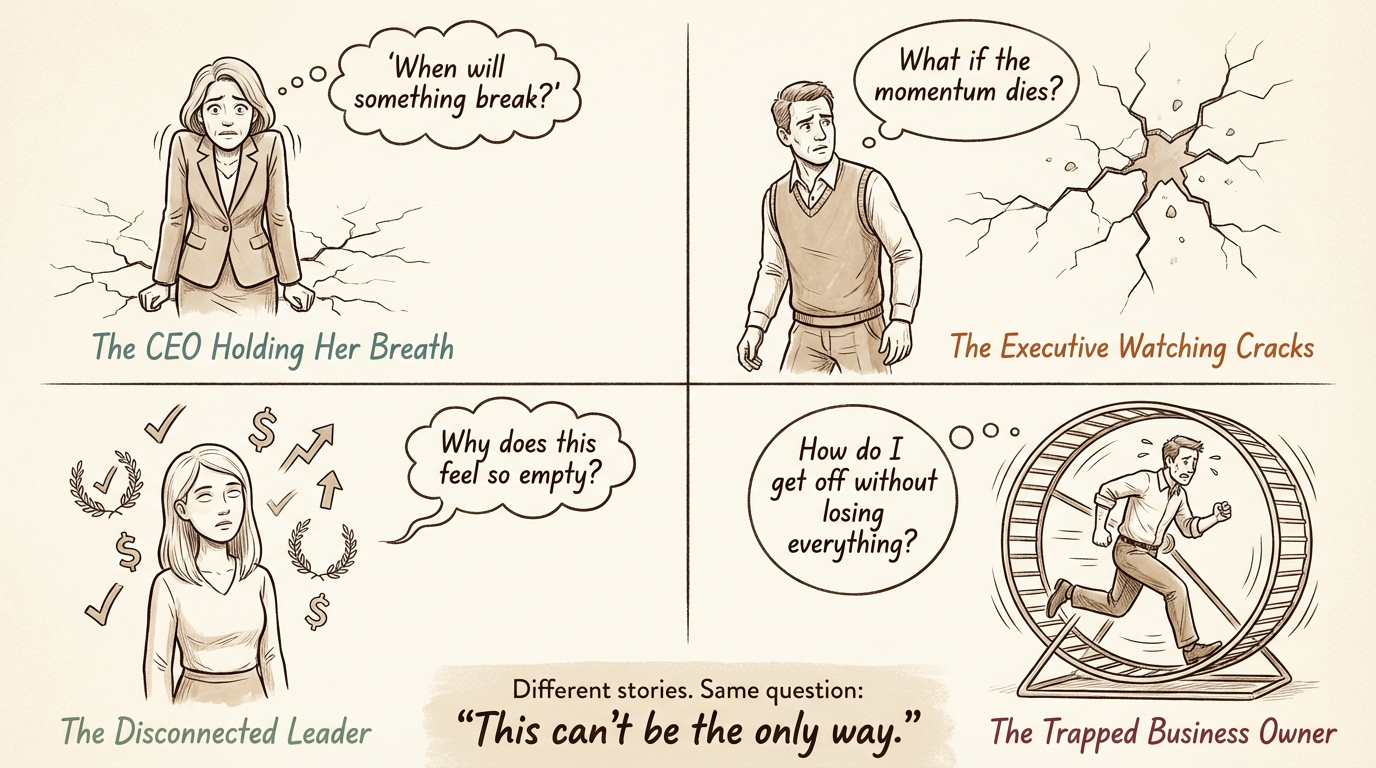
What you're dealing with is the grind.
The dictionary defines it as excessive hard work.
The Grind Operating System: What's Really Happening
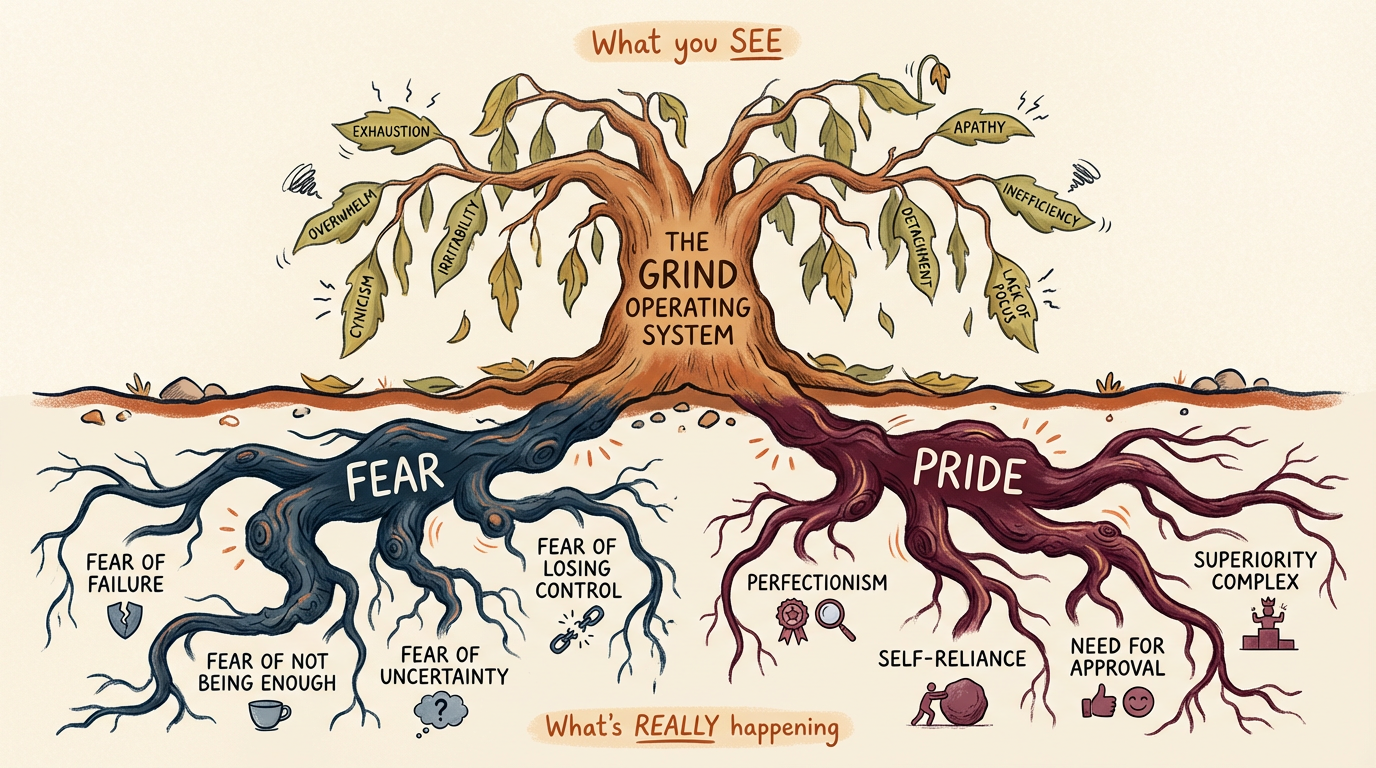
The slow, steady erosion doesn't start with personal or team burnout; it starts with how you make decisions and what drives them. And when I work with CEOs to trace the grind back to its roots, two culprits show up repeatedly: fear and pride.
Fear looks like:
Fear of losing what you've built ("We almost didn't make it through 2020...")
Fear of letting your team down ("They depend on me for their livelihood")
Fear of competitors outpacing you ("If I take my foot off the gas...")
Fear of financial instability returning ("I remember when we were paycheck to paycheck")
Fear of making the wrong hire or decision that costs you ("One bad VP hire could tank us")
Fear of signaling weakness ("What if my team realizes I don't have it all figured out?")
Fear that everything falls apart without you ("Who else around here sees the full picture?")
And then there’s pride; not just arrogance, but pride that wears a disguise:
Perfectionism ("I'm the only one who can do this right")
Hyper independence (“I'd better figure this out on my own”)
Over-responsibility ("If I don't personally handle this, things will surely go sideways”)
Self-validation (“Once we land this deal, they’ll see I've still got it”)
Worth through necessity ("If they don't need me, who am I?")
Comparison (“Other CEOs at this stage have it figured out...I just need to push harder”)
Whether the root is fear or pride, both will keep you and your team grinding...carrying too much weight, at an unsustainable pace, for far too long.
When Grind Manufactures Pressure and Results Justify the Cost
You’ll often hear me tell my clients, “There’s enough pressure in business already without you adding self-inflicted pressure in the mix.”
In grind culture, urgency is the constant hum beneath every decision, conversation, and project. I’m not saying that urgency is never appropriate, because sometimes it absolutely is. The problem is that when urgency becomes the only gear you have, it keeps you in a never-ending cycle of reactive decision-making and busyness. Meanwhile, your team will absorb this and begin modeling the same. They lose access to their own clarity because they're too busy reacting to keep up with the pace you've set.
And margin? Forget about it. In grind culture, margin is the enemy of “making things happen.” Yet leaders need margin to lead. It’s the margin that gives you the space to think clearly, to listen deeply for wisdom, and to discern what’s truly important.
Too often, that “make things happen” laser focus leads to chasing outcomes with little to no regard for how you achieve them.
Exceeded the revenue goal? Great. Never mind that your top three people are mentally and physically exhausted from a relentless seven-month grind and are now updating their resumes.
Closed the deal? Celebrate. Never mind that the way you showed up in that negotiation felt completely misaligned with your values and who you want to be as a leader.
Shipped the product on time? Excellent. Never mind that you haven't had a real conversation with your spouse or children in five months.
The grind doesn’t care about creating a culture where both people and results flourish, and that is why it eventually breaks down.
The question is: What comes next? What if there's a way to lead that doesn't require choosing between results and rest, between driving outcomes and honoring people?
There is.
It’s not a strategy or a productivity hack; it’s a completely different operating system.
It’s called Grace.
All About That Grace: What it Really Means
Grace is divine enablement — power beyond your own that transforms how you lead, how you decide, how you carry responsibility, and ultimately, how you shape the culture around you.
It helps you lead with wisdom, clarity, and strength, especially under pressure.
(And I don’t know about you, but I’ve never met a business leader who doesn’t experience pressure)
The invitation is to move from grind to grace, and discover what is possible when you stop running primarily on sheer willpower and forced urgency, and start operating from a limitless Source.
The beauty is that you don’t have to earn it; you simply need to receive it.
At the time of this writing, I've published four books, given keynote addresses around the globe, and directly mentored and advised several hundred marketplace leaders on grace-empowered business and leadership. It's because of this that I am intimately aware of what some of you may be thinking right now.
"Grace? That sounds soft like I'm supposed to lower my standards and be 'nice' all the time."
"I run a business. I don't have time to sit around waiting while opportunities pass me by."
"Does this mean I stop planning and strategizing and just hope things work out and finances just magically show up? That’s not realistic."
"This sounds religious. I'm not sure it applies to me."
I get it. The word "grace" carries quite a variety of contexts with it, so in order to present it to you as an operating reality for your business leadership, I need to clear up what it’s not.
What Grace Is NOT
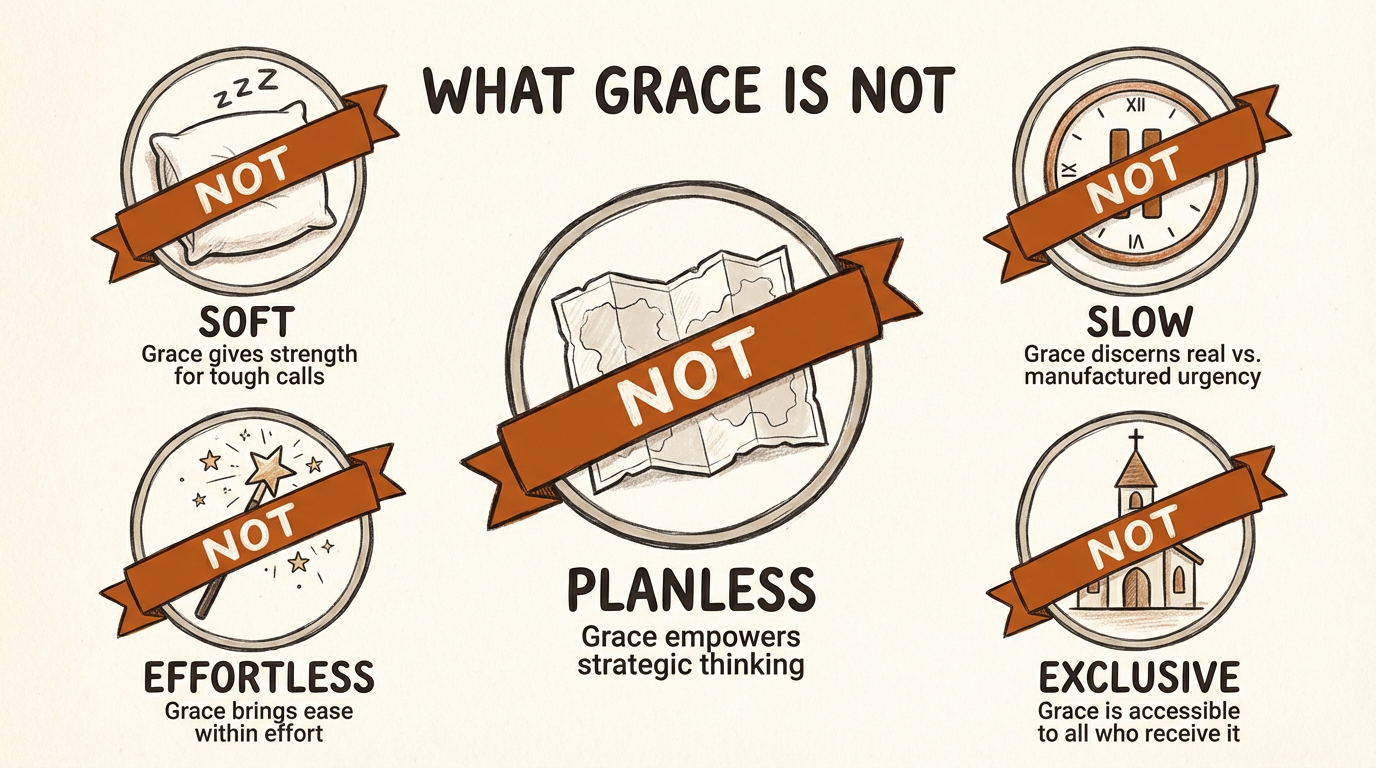
Grace is not soft, passive, or weak.
Grace doesn't mean lowering your standards or tolerating poor performance in the name of being "gracious." Grace gives you the peace, wisdom, and strength you need to make tough decisions and tackle tough conversations while honoring people with honesty.
It’s also not toxic positivity, where you ignore problems and pretend everything is fine rather than addressing issues, organizational and personal. Grace gives you the courage to name what's true without being crushed by the circumstances.
Grace doesn't eliminate urgency or pressure.
Some leaders hear "grace" and think it means slowing down, overthinking every decision, or missing opportunities while waiting for perfect clarity.
That's not it.
Grace helps you discern the difference between real urgency and manufactured pressure. Sometimes grace moves fast, decisively, and confidently. Other times, it slows you down just enough to avoid a costly or unnecessary mistake... or to see a better option. The key is that grace moves with wisdom, not anxiety.
Grace is not devoid of strategy.
Leading from grace doesn't mean you stop planning and strategizing. The difference is that you will hold those plans with open hands, staying responsive to insights and redirection when they come. Grace empowers your strategic thinking, operational execution, and team culture development. It aligns you with wisdom and frees you from the anxiety of thinking everything depends solely on you.
Grace doesn't mean everything comes easy.
Here's a big one: Grace isn't about effortless success or waiting for things to fall into your lap.
You still have to show up, do the work with diligence, face challenges, and persevere through difficulty. The beauty is that you're not doing all of that alone. You're working with a Source of strength beyond your own, which brings an ease within the effort.
You don't need to share my faith to experience this.
My understanding of grace is rooted in my relationship with Jesus Christ. Grace is divine enablement — God's power at work in and through me.
But what I've learned over the years is that the expressions of grace are accessible to anyone willing to receive them. You may not name the Source the same way I do. That's okay.
What matters is that you're open to the possibility that there's power available beyond your own capacity, and that leading from that power is a game-changer for you and your team.
Want to see where you are right now? Take the
ROOTED: A Leadership Foundations Diagnostic. It takes less than ten minutes and gives you an honest picture of the foundation you're leading from.
So what does grace look like in action?
I call it “The GRACE Effect.”
It's the operating system that makes flourishing possible for you, for your team, and for the results you're responsible for. It's what allows you to lead well — not just once in a while when conditions are ideal, but consistently, even when the stakes are high and the challenges are real.
It’s a leadership pathway and operating framework that you can begin applying today.
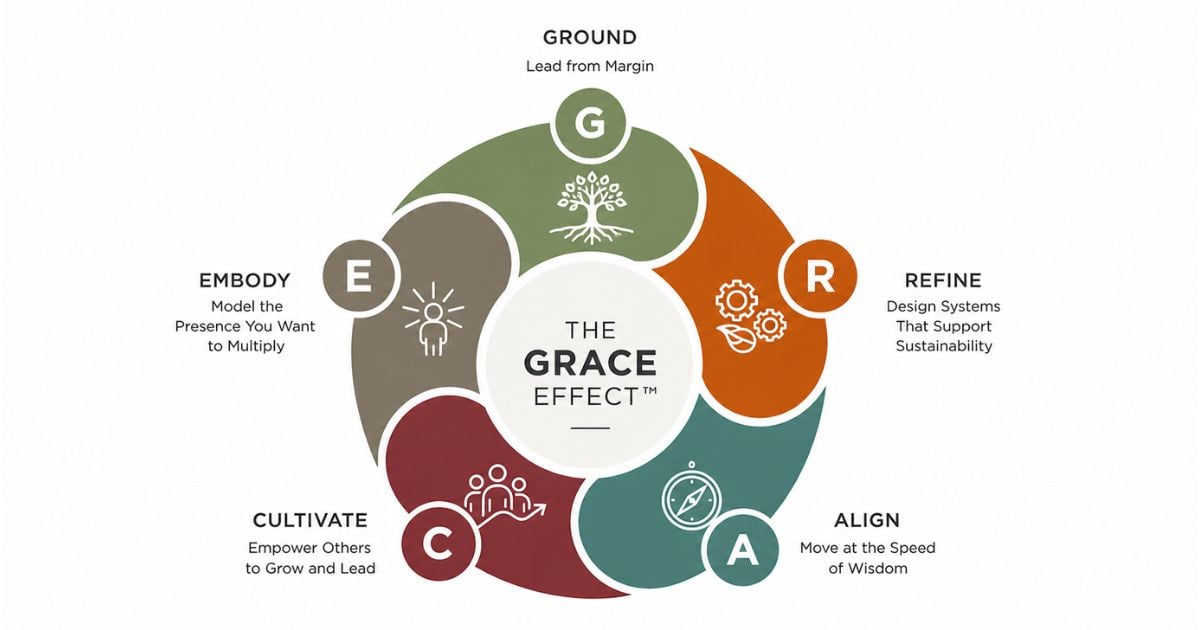
G – Ground: Lead from Margin
What it means:
Creating intentional space to pause, reflect, and renew. Leading from peace and rest. Margin helps you access rational, emotional, and spiritual intelligence.
What it looks like in practice:
Daily rhythms that create space to think before reacting
Protecting white space in your calendar as fiercely as you protect meetings
Regular practices that connect you to wisdom beyond your own
What shifts when you embrace it: Decision quality improves. You move from reactive to responsive. Your team gains permission to create their own margin because they see you protecting yours.
|
Example: A client added "business meetings with God" to her morning routine — 30 minutes after her workout to pause and listen before the day began. Within two weeks, she already noticed a substantial decrease in anxiety and greater clarity in major decisions for her rapidly growing agency. It's now become a non-negotiable rhythm. |
R – Refine: Design Systems That Support Sustainability
What it means: Creating workflows that reduce friction and create flow. Building systems that serve both people and outcomes.
What it looks like in practice:
Meeting rhythms that actually move work forward rather than creating busy work
Communication structures that prevent inbox overwhelm
Processes that multiply capacity rather than drain it
What shifts when you embrace it: The same amount of effort produces significantly (often exponentially) better results. Your team stops feeling like they're swimming upstream.
|
Example: One client who typically avoids meetings like the plague agreed to add just one 30-minute bi-weekly check-in with a key team member. That one hour a month, invested in clarity and alignment, multiplied their team's capacity and dramatically improved the consistency of results. |
A – Align: Move at the Speed of Wisdom
What it means: Clear priorities over forced urgency. Decisions based on sustainable pacing, not FOMO or external pressures. This is “the pace of grace.”
What it looks like in practice:
Saying no to good opportunities that aren't aligned
Choosing strategic timing over manufactured pressure
Boundary practices that protect aligned work from constant urgency
What shifts when you embrace it: You stop chasing every opportunity and start creating focused momentum. Your team knows where they're going and why.
|
Example: A client had a partnership agreement on the table that looked great on paper, with fast growth and immediate revenue. But when she slowed down enough to get clear, she realized the partnership would require her to take on operational responsibilities that didn't align with her calling or strengths. It was the only way the deal could work, which meant it wasn't the right deal. She said no. Months later, a different opportunity emerged that not only delivered the growth she desired but did so in a way that allowed her to stay in her lane while strengthening her company's core mission. |
C – Cultivate: Empower Others to Grow and Lead
What it means: Creating an environment where your team has clarity, trust, and permission to own their part and grow. Collaboration replaces control.
What it looks like in practice:
Creating forums for honest dialogue and collaborative problem-solving
Inviting input and diverse perspectives rather than rescuing and having all the answers
Allowing people to solve problems that you could solve faster
Building trust through transparency and shared ownership
What shifts when you embrace it: Your team steps up, ownership increases, and you stop being the bottleneck.
|
Example: A small business CEO client struggling to release control gave two team members real decision-making authority over functions she'd always owned. They didn't just handle it; they excelled. Within months, she was able to step back from daily operations significantly, and the business ran smoother than ever. She'd spent years making herself indispensable. Turns out, empowering others was the real leadership move. |
E – Embody: Model the Presence You Want to Multiply
What it means: Your leadership posture shapes culture. You don’t just say it, you live it. You become the pace-setter and culture carrier.
What it looks like in practice:
Taking rest so your team has permission to rest
Showing up grounded so your team can ground themselves
Modeling the trust and peace you want to see multiplied
What shifts when you embrace it: Culture transformation flows from who you're becoming.
|
Example: I walked into the conference room of one of my client's technology companies and saw "Grace Over Grind" written on the whiteboard, front and center where strategic plans get hashed out. It wasn't a motivational poster. It was how they'd chosen to operate, because their CEO had modeled it first. The team adopted a simple practice: at some meetings, each person shares a win “beyond them.” For example, a contract that came through against the odds, a solution that emerged after pausing to listen, a resource that showed up exactly when needed. The CEO didn't create a grace-empowered culture by announcing it. She created it by embodying grace herself, and her team multiplied it. |
The Starting Point: It Begins With You
What I've learned after more than a decade of walking this path myself and guiding leaders through it is that you can't multiply what you don't carry yourself.
Before you can create margin for your team (Ground), you have to protect your own.
Before you can build sustainable systems (Refine), you have to be willing to let go of the way you've always done things.
Before you can lead with aligned priorities and pace (Align), you have to get honest about what's actually driving your decisions...is it wisdom or anxiety?
Before you can empower others to grow (Cultivate), you have to stop rescuing and start trusting.
Before you can shape a grace-empowered culture (Embody), you have to become someone who carries grace yourself.
So what actually becomes possible when you make this shift?
You lead a team that's energized instead of exhausted (and Monday mornings don’t feel like a collective groan).
You finish work strong without finishing empty (and your most important relationships aren’t getting the scraps of your energy).
Trust, creativity, shared ownership, and joyful collaboration are commonplace in your culture (you’re no longer the bottleneck!)
You build the kind of momentum that multiplies and gets results without sacrificing the well-being of your team
Your impact goes well beyond revenue!
With grace-empowered leadership, your efforts are multiplied in ways you couldn't orchestrate on your own. I've watched CEOs navigate crises with peace that confused those around them. I've seen breakthrough solutions emerge not from 80-hour work weeks, but from leaders who created margin to listen. I've celebrated with founders who built flourishing businesses without sacrificing their marriages, health, or souls.
This isn't theory. It's what happens when both people and results are allowed to flourish because the leader chose a different operating system.
The question now is...are you ready for this shift?

The Starting Point Is Always Ground
You can want better systems, clearer priorities, a more empowered team, but every journey through The Grace Effect Framework begins in the same place: Ground.
Ground is where you build the foundation that makes everything else work harmoniously. It’s how you begin to consistently access the power beyond you that produces flourishing in you, your team, and results.
ROOTED: A Leadership Foundations Diagnostic is a tool that shows you where you are within Ground. You’ll see what's working, what's missing, and what to focus on first.
It takes less than ten minutes and gives you an honest picture of the foundation you're leading from right now.